
"Is this puppy KCI or non-KCI?" is one of the first questions Indian buyers ask, and one of the most misunderstood. Many people assume a KCI puppy is the "real" purebred and a non-KCI puppy must be a cross. That is not how it works. KCI is a register of pedigrees, not a test of breed or health. A Labrador born to two unregistered Labradors is still a Labrador.
This guide explains what KCI registration actually is, what you get with and without it, why KCI puppies cost more, who genuinely needs KCI papers and who does not, and how to check that a puppy is what the seller says it is, with or without papers.
The short answer
- KCI puppy: from a litter registered with the Kennel Club of India. Both parents are KCI registered, and the puppy gets a pedigree certificate.
- Non-KCI puppy: no kennel club pedigree. It can still be 100% purebred. The breed is vouched for by the breeder or seller, not by a club register.
- Non-KCI does not mean crossbred. A crossbreed has parents of different breeds. Paperwork has nothing to do with it.
- Buy KCI if you want to show, breed or keep a documented bloodline. Non-KCI is fine for most family pets.

What is KCI?
The Kennel Club of India (KCI), headquartered in Chennai, is the best-known body in India that keeps a register of pedigree dogs. It records which dog was born to which parents, registers litters from registered parents, and runs and licenses dog shows across the country, along with other canine events.
When people say a puppy is "KCI", they mean the puppy's litter has been registered with the club. For that to happen:
- Both the father (sire) and the mother (dam) must already be registered with KCI as the same breed, and are expected to carry a club-approved microchip.
- The breeder must register the litter within the club's deadline, usually within about four months of birth.
- Once a puppy is sold, its ownership is transferred into the new owner's name through the club.
The result is a registration certificate that names the puppy, its breed, its parents and their registration numbers. Over generations, those records build up into a pedigree you can trace back.
KCI is not the only club. The Indian National Kennel Club (INKC), based in Mumbai, is a separate organisation with its own register and shows. Always check which club's papers you are being offered.

What is a non-KCI puppy?
A non-KCI puppy is any puppy whose litter was not registered with the Kennel Club of India. That is all the term means. It says nothing about whether the puppy is purebred, healthy, well-bred or badly bred.
In India, a large share of genuine purebred puppies are non-KCI. Common reasons:
- The parents were never registered. Many good breeders keep healthy purebred dogs but never paid for registration, because their buyers want pets, not show dogs.
- The paperwork missed the deadline. If a litter is not registered in time, the puppies cannot be registered as a normal pedigree litter.
- Only one parent is registered. One registered parent is not enough. Both must be.
- The parents are registered with a different club, such as INKC, or abroad.
- The breed or cross is not recognised. Designer crosses such as the Maltipoo cannot be registered at all.

KCI vs non-KCI: side by side
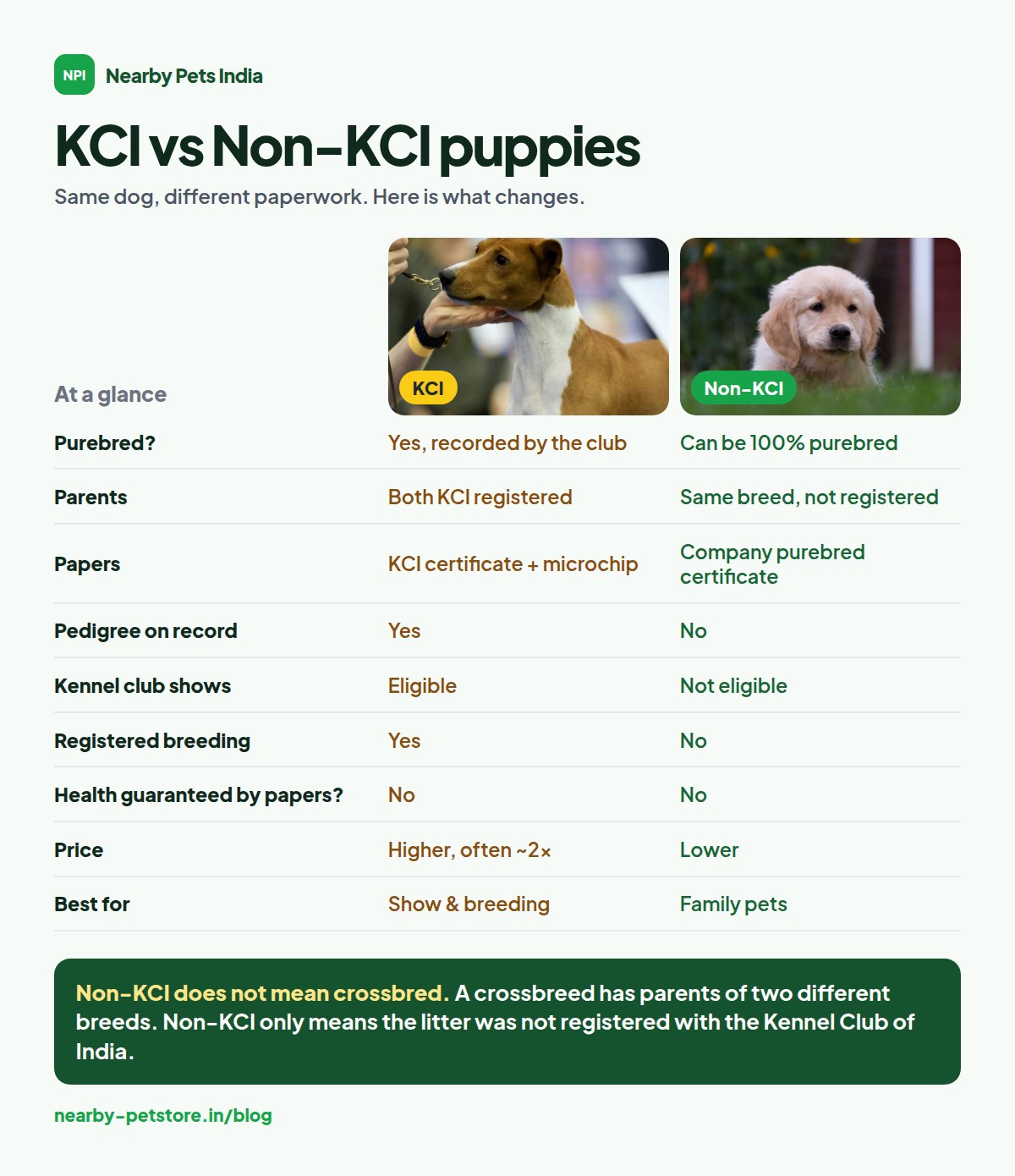
| KCI-registered puppy | Non-KCI purebred puppy | |
|---|---|---|
| Purebred? | Yes, recorded by the club | Can be fully purebred; vouched for by the breeder or seller |
| Parents | Both KCI registered, same breed | Same breed, but not registered with KCI |
| Paperwork | KCI registration certificate, ownership transfer, microchip | Breeder or company purebred certificate, vaccination record |
| Traceable pedigree | Yes, through the club register | No official record |
| Kennel club shows | Eligible | Not eligible for KCI pedigree classes |
| Registered breeding | Puppies can be KCI registered if the other parent is too | Puppies cannot be registered as a KCI pedigree litter |
| Health | Not guaranteed by registration | Not guaranteed by the lack of it either |
| Price | Higher, often close to double | Lower |
| Best for | Show, breeding, documented bloodlines | Family companions and pets |
Does non-KCI mean the puppy is crossbred?
No. This is the biggest myth around KCI. "Crossbred" describes a puppy's parents. "Non-KCI" describes its paperwork. They are different things.
- Purebred: both parents are the same breed. A puppy can be purebred with or without KCI papers.
- Crossbreed: the parents are two different breeds, often on purpose, such as a Maltipoo (Maltese x Poodle). These can never be KCI registered as a breed.
- Mixed breed: ancestry from several breeds or unknown parents. Also not registrable as a pedigree.
So every crossbreed is non-KCI, but most non-KCI puppies sold as a named breed are not crossbreeds. The honest caveat: without a club register, the breed rests on the seller's word. That is why who you buy from matters more for a non-KCI puppy, and why you should check the points further down.


Myths about KCI puppies
Myth: A KCI puppy is healthier.
KCI registration records who the parents are. It is not a health test. A registered puppy can still have inherited problems, and an unregistered one can be perfectly healthy. Health comes from good breeding, vaccinations, deworming and early vet care.
Myth: A KCI puppy will look better.
Two puppies from the same type of parents look the same whether or not the litter was registered. Show-quality looks come from carefully selected parents, which registered breeders are more likely to track, but papers alone do not make a dog show quality.
Myth: Non-KCI puppies are all from puppy mills.
Many small, caring home breeders never register their dogs. Equally, papers do not prove a puppy was raised well. Judge the breeder and the puppy, not just the certificate.
Myth: I can get KCI papers later.
A pedigree comes from a registered litter. If the parents were not registered, the puppy cannot later be given papers listing them. Decide before you buy.

Who should buy a KCI puppy?
KCI papers are worth paying for if any of these apply to you:
- You want to show your dog at kennel club dog shows. Pedigree classes need a registered dog.
- You plan to breed. If you want to sell registered puppies one day, both your dog and its mate must be registered.
- You want a documented bloodline for a working or sporting breed, for example a German Shepherd from working lines or a Labrador from field lines.
- You want certainty on paper that the parents are what the seller says, and you are happy to pay for it.
- Resale or stud value matters to you. A registered dog with a good pedigree carries more value in the breeding world.
Who does not need a KCI puppy?
- Families looking for a companion that will not be shown or bred.
- Owners who plan to neuter or spay their pet, which most vets recommend for dogs not used for breeding.
- Buyers on a budget who would rather spend the difference on good food, vaccinations, training and vet care.
- Anyone choosing a designer cross such as a Maltipoo, which cannot be registered anyway.
For these buyers, a company-certified purebred puppy from an accountable seller, with vaccination records and a health guarantee, gives the same dog for less money.

Why does a KCI puppy cost more?
The puppy itself is not different. You are paying for the registered pedigree and what it takes to produce one:
- Registered parents cost more to buy, and breeders who register usually keep fewer, more selected dogs.
- The breeder pays for club membership, microchips, litter registration and transfers.
- Registered litters are much rarer in India than unregistered ones, so supply is tight.
On Nearby Pets India, choosing the KCI certificate option usually makes a puppy cost close to twice the company-certified price for the same breed and gender. You can see both prices on each breed's page before you decide, for example on the Labrador Retriever, Golden Retriever and German Shepherd pages.





KCI and company certificates at Nearby Pets India
Every dog breed page on our site has a Certification choice:
- Company Purebred Certificate (the default): our written certificate stating the puppy's breed. It comes with the puppy's vaccination and deworming record, a vet health check and our 7-day health guarantee. It is not a kennel club registration and cannot be used to enter KCI shows or register a litter with KCI.
- KCI Certificate: a puppy from a KCI-registered litter, with KCI registration in the puppy's name. Choose this if you want to show or breed.
A few breeds come with the company certificate only. The Maltipoo is a cross, so KCI does not register it, and some native Indian breeds such as the Rajapalayam, Kanni, Mudhol Hound and Chippiparai are currently offered without the KCI option. Puppies go home at 42–60 days old, whichever certificate you choose.
Not sure which to pick? Ask us on WhatsApp before you book. If you are not going to show or breed, we will tell you that the company certificate is enough.
How to check a KCI puppy before you pay

- Ask for both parents' KCI registration numbers and copies of their certificates. Both must be the same breed as the puppy.
- Ask for the puppy's microchip number and its litter or registration details.
- Confirm the details with the Kennel Club of India. Do not rely only on a photo of a certificate.
- Get the ownership transfer done into your name. Without it, the dog stays registered to the breeder.
- Ask when the papers will reach you. Registration and transfer are processed by the club and take time, so get the timeline in writing.
- Still check health. Vaccination card, deworming dates, a vet check and a written health guarantee matter as much as the pedigree.
How to check a non-KCI puppy is purebred
- See the parents, in person or in clear, recent photos and videos. Both should look like typical examples of the breed.
- Compare the puppy with the breed standard: coat, colour, ear set, muzzle, size for its age. Remember that young puppies of similar breeds can look alike.
- Get the breed in writing, on a purebred certificate or invoice, from a seller with a real address and a track record.
- Insist on vaccination and deworming records and a health guarantee.
- Be wary of prices far below the market for a popular breed. That is the most common sign of a mixed litter sold under a breed name.
- Consider a DNA breed test if you are still unsure. It is optional, and for most families a trustworthy seller is the practical check.
Our guide to buying a pet online in India safely covers more warning signs, and what a pet costs in its first year helps you budget for everything after the purchase price.

The bottom line
KCI papers are a pedigree record. They matter if you will show your dog, breed from it, or want its bloodline documented, and for those buyers they are worth the higher price. For everyone else, a healthy, well-raised purebred puppy with a company certificate, full vaccination records and a health guarantee is the same dog at a lower cost. And no, a puppy without KCI papers is not a crossbreed. It is a puppy without KCI papers.
Frequently asked questions
What does KCI mean when buying a puppy?
KCI stands for the Kennel Club of India, the Chennai-based body that keeps the pedigree register for dog breeds in India. A KCI puppy comes from a litter registered with the club, which needs both parents to be KCI registered. The puppy gets a registration certificate that records its breed and parentage.
Is a non-KCI puppy a crossbreed?
No. A non-KCI puppy is simply a puppy whose litter was not registered with the Kennel Club of India. Both parents can be the same pure breed. Many purebred dogs in India are never registered because the breeder's dogs are unregistered, the paperwork was not done in time, or the dogs are registered with another club. A crossbreed is a puppy whose parents are different breeds.
Is a KCI puppy healthier than a non-KCI puppy?
Not automatically. KCI registration records pedigree, not health. A registered puppy can still have health problems, and an unregistered puppy can be perfectly healthy. For health, look at the vaccination and deworming record, a vet check, the parents' health and the seller's health guarantee.
Who should buy a KCI-registered puppy?
Buy KCI if you want to show your dog at kennel club shows, plan to breed and sell registered puppies, want a documented pedigree for a working or sporting line, or simply want the parentage on record. If you want a family companion that you will not show or breed, a company-certified purebred puppy from an accountable seller is usually enough.
Why does a KCI puppy cost more?
Registered parents cost more to buy and keep, the breeder pays for club membership, microchips and registration, and registered litters are fewer. On Nearby Pets India a KCI-certified puppy usually costs close to twice the company-certified price of the same breed and gender. The puppy itself is no different; you are paying for the documented pedigree.
Can I get KCI papers for my dog later?
Full pedigree papers can only come from a registered litter, so a non-KCI puppy cannot later get papers showing registered parents. Kennel clubs may register such a dog with its parentage shown as unknown, but that is not a pedigree and does not let you register its puppies as a pedigree litter. If you think you will want KCI papers, choose KCI when you buy.
How do I check that KCI papers are genuine?
Ask for the KCI registration numbers of both parents, the puppy's microchip number and its litter or registration details, then confirm them with the Kennel Club of India. Make sure the ownership transfer is done into your name, and ask when the papers will reach you, because registration and transfer are processed by the club and are not instant.
Does KCI register Maltipoo or other designer dogs?
No. Designer crosses such as the Maltipoo (Maltese x Poodle) are not a recognised breed, so the Kennel Club of India does not register them. That is why Maltipoo puppies on our site come with a company certificate only. Treat any seller offering KCI papers for a designer cross with suspicion.
How can I tell if a non-KCI puppy is really purebred?
Ask to see both parents or clear photos and videos of them, compare the puppy with the breed standard as it grows, and buy from a seller that puts the breed in writing and gives a health guarantee. A dog breed DNA test can add confidence if you are unsure, but for most families a trustworthy seller and the parents' appearance are the practical checks.
What is the difference between KCI and INKC?
Both are Indian kennel clubs that keep pedigree registers. The Kennel Club of India (KCI) is based in Chennai, and the Indian National Kennel Club (INKC) is a separate organisation based in Mumbai. Their registers and shows are separate, so check which club a puppy's papers come from and which club runs the shows you plan to enter.
Do I need KCI papers to register my dog with the municipality?
No. Municipal pet registration in Indian cities asks for things like the owner's details and the rabies vaccination record, not a kennel club certificate. KCI papers are about pedigree, not about a licence to keep a dog.